Leg Lift
The leg lift is the motion of raising the lead leg.
By lifting the leg, the pitcher raises their center of gravity.
This helps store potential energy, which is then converted into forward momentum during the stride and drive toward home plate.
If lower body strength is insufficient, the pitcher may lose balance and become unstable, causing the pitching motion to break down.
A breakdown in mechanics can lead to poor control.
This is one of the main reasons why lower body strength is essential for pitchers.
How High Should You Lift Your Leg?
Lifting the leg higher can be beneficial, but only if balance is maintained.
If raising the leg too high causes instability, it defeats the purpose.
Trying too hard to maintain balance may also create unnecessary tension not only in the lower body but also in the upper body, so it is important not to overdo it.
Posture During the Leg Lift
During the leg lift, the center of gravity is higher, making it more difficult to maintain balance than when standing on both feet.
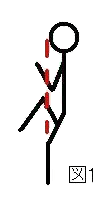
The ideal posture is shown in Figure 1.
By slightly bending the knee, the pitcher can maintain balance while keeping the back straight.
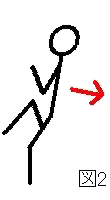
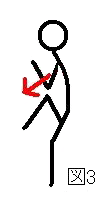
Poor examples include leaning toward first base or rounding the back (Figures 2 and 3).
If the pitcher transitions into the stride from these positions, the body will drift—Figure 2 toward first base, and Figure 3 toward third base.
However, doesn’t Figure 1 look like the pitcher might fall backward?
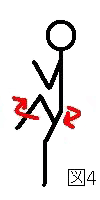
To address this, as shown in Figure 4, from the end of the leg lift into the stride phase, the pitcher uses the hips to shift orientation.
The lifted leg moves toward the area between shortstop and third base (toward second base direction), while the back turns toward home plate.
It is important not to twist the knees or upper body.
Instead, rotate the body using the hips.
This naturally shifts the center of gravity toward home plate.
This movement contributes to forward momentum during the stride.
A well-known example is Hideo Nomo, who succeeded in MLB.
His “tornado” delivery rotates the body so much that his jersey number is clearly visible to the catcher.
While not every pitcher needs to rotate that much, it highlights an important concept to understand.
Leg Lift and the Quick Pitch
A quick pitch is used when runners are on base to prevent stolen bases by using a more compact and faster delivery.
In these situations, pitchers typically throw from the set position rather than a full windup.
Specifically, the pitcher minimizes the leg lift and immediately transitions into the downward motion.
In some cases, the pitcher may already lower their center of gravity in the set position, effectively skipping the downward phase altogether.
The trade-off is that without a full leg lift, less potential energy is generated.
This can reduce forward momentum during the stride and result in lower pitch velocity.
The more a pitcher emphasizes speed and compactness in their motion, the more they may sacrifice power.